
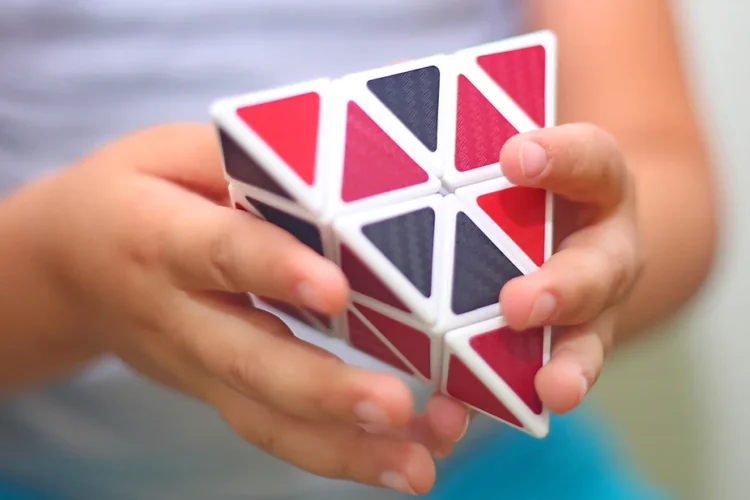
With his eyes fixed on a handful of colourful pieces, Ilyass remains silent. Across from him, Dr. Khaoula Mammad watches him closely. “Choose the colours you like and build whatever you want,” she suggests.
Within minutes, Ilyass assembles the pieces into an intricate structure of geometric shapes. The symmetry is flawless, and the design is remarkably sophisticated for an eleven-year-old.
“I call him our Einstein,” smiles the neuropsychologist who leads the Universal Healthy Brain Center (UHBC) in Témara, in Morocco’s Rabat-Salé-Kénitra region. “Behind his silence lies an exceptionally logical mind. Our role is simply to help him realise his potential,” she says warmly.
Ilyass lives with mild autism spectrum disorder. A football enthusiast, he is particularly fascinated by the universe, galaxies, and the world of Star Wars. In his imagination, he is already travelling through space. His dream is to become an engineer at NASA.
 For his mother, Soumaya, her son was long described as a “daydreamer” who was “lost in his own world.” During primary school, meetings with teachers were frequent, as she recalls. “They struggled to understand his behaviour. Yet I knew he had tremendous abilities. I just wanted him to receive the right support.” After benefiting from an individualised learning programme at school, the family turned to the specialised UHBC centre, led by Dr Mammad.
According to the educational neuropsychologist, Ilyass’s challenges reflect a much broader reality. “Many children with neurodevelopmental disorders remain misunderstood, and some are even misdiagnosed. Autism can sometimes be mistaken for other psychiatric conditions, such as schizophrenia, leading to completely inappropriate treatment approaches,” she regrets.
 Long before becoming a doctor in behavioural and cognitive neurobiology, a neuropsychologist, and a psychotherapist, Khaoula Mammad experienced difficulties with learning and adaptation herself.
“These experiences were never obstacles,” she explains. “They became the starting point for my mission. I wanted to create a place where no child would ever feel misunderstood.”
“Every Child Is Unique”
This vision led to the creation of the Universal Healthy Brain Centre, a specialised facility dedicated to assessing and supporting children with neurodevelopmental disorders. UHBC teams work with children with autism spectrum disorders, learning and language difficulties, developmental delays, and emotional, behavioural, cognitive, and academic challenges.
At the heart of the model is a simple belief: every child has unique potential that can only emerge through individualised support. The clinic therefore brings together neuropsychologists, speech therapists, psychomotor therapists, and educational support specialists in a single multidisciplinary team. Cases are discussed collectively to design a personalised therapeutic pathway for each child.

“Every case is unique,” Dr Mammad often reminds her team.
Support extends well beyond the centre’s walls. Parents and teachers are involved throughout the therapeutic journey through a comprehensive, 360-degree approach. A digital platform enables families to track their child’s progress and learn the techniques used in therapy sessions, so they can continue the work at home.
“We want parents to become active partners in their child’s development,” says Achraf Hachimi, UHBC’s Head of Information Technology.
 For Ilyass, the results came quickly. After a year of support, calls from the school stopped.
“In fact, his teacher called me to ask what we had done. She found his progress remarkable,” Soumaya says with a laugh.
She also noticed that Ilyass himself recognised the value of the support he was receiving.
“When he misses a session, he grows anxious.”
Intelaka: A Program Supported by the African Development Bank
This success story is also an entrepreneurial tale.
When Khaoula Mammad decided to open her centre, she had a clear vision yet limited resources.
“Like many entrepreneurs, turning an idea into reality was the biggest challenge,” she says.
The Intelaka programme proved to be a turning point. The financial support it provided enabled her to establish a professional facility, acquire the necessary equipment, and, most importantly, build a team that shared her ambition to deliver outstanding support to neurodivergent children.
Launched under the leadership of His Majesty King Mohammed VI, Intelaka forms part of a broader package of financial and technical support mechanisms implemented by Morocco’s Ministry of Economy and Finance, in partnership with Bank Al-Maghrib—the country’s central bank—and the public guarantee institution Tamwilcom. The programme aims to strengthen the entrepreneurial ecosystem by improving access to financing and technical support for entrepreneurs and very small and medium-sized enterprises.
The African Development Bank Group supports these initiatives through the Employment and Entrepreneurship Support and Financing Program in Morocco (PAFE-Emplois), which is funded with €119 million.
The early years were not easy. The team had to persuade families of the importance of early intervention, build a multidisciplinary workforce, and ensure the project’s financial sustainability.
“Every obstacle reminded me of the true purpose of this journey: children were waiting for answers, and families were seeking support,” says Dr Mammad.
A Model with Growing Impact
Six years later, the results speak for themselves.
Between 500 and 1,000 children have directly benefited from the centre’s services. Activity has grown by 25 to 30 percent annually, and around ten skilled jobs have been created, according to Mouad Alaoui, the centre’s Administrative Manager.
Today, UHBC relies on a broad ecosystem of specialists, mobilised to meet each child’s specific needs.
Its next challenge is to replicate the model across Morocco’s major cities to meet growing demand.
For Dr Mammad, however, the ambition goes far beyond merely expanding the organisation.
“We are potential enablers,” she says with conviction. “These children have extraordinary, often overlooked abilities. What they need is confidence and an environment in which their differences become a strength.”
His words hit home for young people like Ilyass, who continues to dream of the stars—and may one day help humanity explore them.


0 Comments