
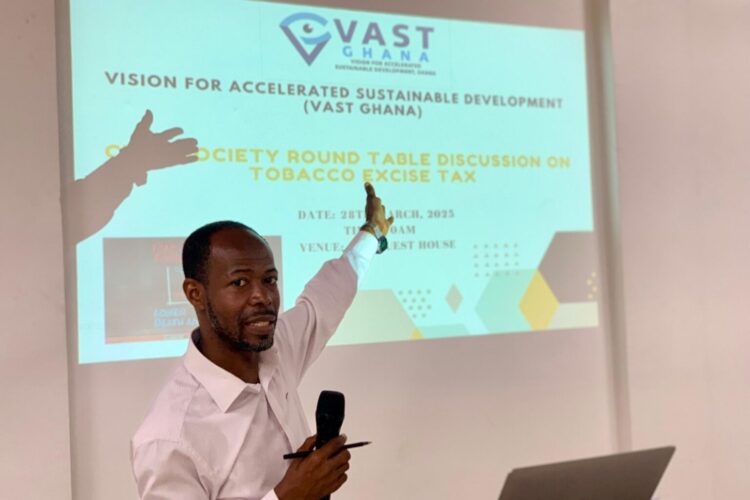
Vision for Accelerated Sustainable Development (VAST) Ghana has called on the government to introduce bolder excise tax reforms in the 2026 Mid-Year Budget Review, urging higher taxes on tobacco and unhealthy products to improve public health while increasing domestic revenue.
In a statement issued on Sunday, the organisation commended the Ministry of Finance and the Ghana Revenue Authority (GRA) for implementing the Excise Duty Amendment Act, 2023, saying the reforms have significantly boosted government revenue.
According to VAST Ghana, tobacco excise revenue increased from about GH¢176 million in 2022 to GH¢371 million in 2023, representing a 107 percent increase, before rising further to GH¢713 million in 2025. It added that excise tax collections on sugar-sweetened beverages reached GH¢1.08 billion in 2023 and GH¢1.68 billion in 2024.
Despite these gains, the organisation said tobacco and other unhealthy products continue to impose a heavy health and economic burden on the country.
It cited estimates showing that tobacco kills more than 6,700 people annually in Ghana and cost the economy about GH¢668 million in 2019. It also noted that non-communicable diseases linked to tobacco, alcohol and unhealthy diets account for more than 94,000 deaths each year, representing over 45 percent of all deaths nationwide.
VAST Ghana is therefore urging the Ministry of Finance to increase the specific excise tax on cigarettes from the current GH¢0.28 per stick to GH¢1.00, arguing that the move would bring Ghana closer to the World Health Organization’s recommendation that tobacco taxes account for at least 70 percent of the retail price.
The organisation also called for automatic annual adjustment of tobacco taxes to account for inflation and economic growth, the introduction of digital tax stamps to strengthen enforcement, and a hybrid excise tax system for alcohol, sugar-sweetened beverages and other unhealthy products. It further recommended the introduction of excise taxes on ultra-processed foods high in sugar, salt and unhealthy fats.
VAST Ghana also appealed to government to earmark part of the revenue generated from health taxes to support non-communicable disease prevention, health promotion, smoking cessation programmes, public health infrastructure, free primary healthcare and the Ghana Medical Trust Fund.
Executive Director of VAST Ghana, Labram Musah Massawudu, said the 2023 reforms demonstrated that health taxes could deliver both public health and fiscal benefits but stressed that further action is needed.
“Ghana cannot afford to let industries that profit from addiction and disease dictate our national tax policy. The 2023 reforms were a great start, but to truly protect our youth and the poor, we must increase the excise tax on tobacco, implement a hybrid system for alcohol and sugar products, introduce excise tax on ultra-processed foods, and ensure that the money collected goes directly back into saving Ghanaian lives,” he said.
VAST Ghana said it remains ready to work with government and other stakeholders to advance progressive excise tax reforms that will improve health outcomes while strengthening Ghana’s domestic revenue mobilisation.


0 Comments