
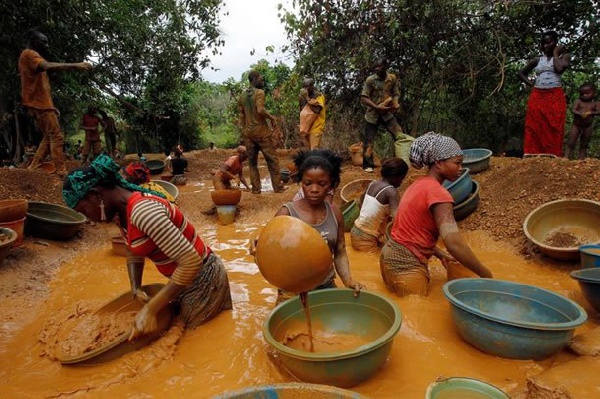
Women working in artisanal and small-scale mining (ASM) in southwestern Ghana face simultaneous economic, social, health and reproductive challenges, according to a new study.
The study, titled Women’s Resilience in the Rough: Navigating Livelihoods in Artisanal and Small-Scale Mining, examines why women continue to participate in the sector despite the risks and difficulties associated with mining.
The research, conducted by Dr Kenneth Joseph Bansah, Abigail Boafo, Michelle D.S. Boakye, Loretta Baidoo, Paul Junior Acquah and Lilian Owusu, draws on ethnographic evidence from ASM communities in southwestern Ghana.
It found that economic hardship is a major factor driving women into mining. Some participants reportedly entered the sector after losing parental or family support, while others turned to mining to provide for themselves and relatives.
Women in ASM commonly perform tasks including carrying loads, crushing and grinding ore, washing and panning. According to the study, these activities expose them to hazardous working conditions.
The researchers also highlighted concerns over mercury exposure, particularly where chemicals are used without adequate protective clothing. Such exposure can have implications for reproductive health, the nervous system and immune function.
Poor sanitation, limited access to healthcare and inadequate safety equipment were also identified as factors increasing health and safety risks for women at mining sites.
Despite these challenges, the study found that women continue to participate in ASM because of economic necessity, hope and their desire to support themselves and improve the wellbeing and future prospects of their children.
The researchers describe these overlapping pressures as a “quadruple burden”, covering economic insecurity, social obligations, health and safety risks, and reproductive responsibilities.
The study introduces a Resilience-Mediated Quadruple Burden Framework, which explains how women navigate these challenges through various adaptive strategies while maintaining their livelihoods.
The researchers call for improved access to education, stronger labour rights, safer working conditions and measures to reduce gender-based discrimination in the sector.
They argue that addressing these challenges could improve women’s wellbeing and contribute to progress on the Sustainable Development Goals, particularly poverty reduction, health and wellbeing, and gender equality.
Clink the link below for a copy of the study:



0 Comments