
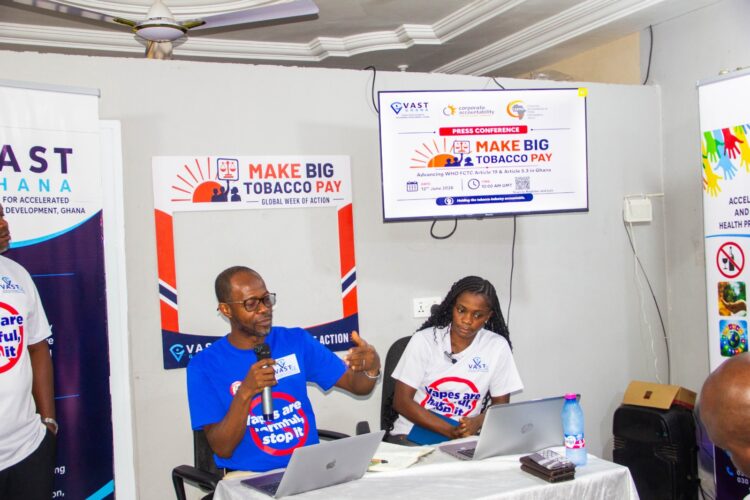
The Vision for Accelerated Sustainable Development Ghana (VAST Ghana) has called on the Government of Ghana to take stronger action against the tobacco industry by implementing measures that hold tobacco companies financially accountable for the health, economic and environmental damage caused by their products.
Speaking at a press conference in Accra as part of the Global Week of Action on “Make Big Tobacco Pay,” Executive Director of VAST Ghana, Labram M. Musah, urged government to begin implementing Article 19 of the World Health Organization Framework Convention on Tobacco Control (WHO FCTC), which encourages countries to pursue civil and criminal liability measures against the tobacco industry.
According to Mr. Musah, tobacco use contributes to about 6,700 deaths annually in Ghana and imposes an estimated GH₵668 million in healthcare costs and productivity losses on the economy each year.

VAST Ghana argued that the “Polluter Pays Principle” should be applied to the tobacco industry, requiring companies to bear the costs associated with tobacco-related diseases, environmental cleanup, waste management and smoking cessation programmes.
Among its key demands, the organisation called on government to establish mechanisms to recover healthcare and environmental costs linked to tobacco use, integrate the polluter-pays principle into tobacco control policies, and require tobacco companies to finance the collection and disposal of cigarette waste.
The group also urged authorities to strengthen implementation of Article 5.3 of the WHO FCTC to prevent tobacco industry interference in public health policymaking, accelerate tobacco tax reforms, and tighten regulations on emerging nicotine products such as e-cigarettes and vapes.

VAST Ghana further called for tobacco waste management to be incorporated into national environmental and sanitation strategies, citing the growing environmental impact of discarded cigarette filters, which contain plastic materials and toxic chemicals.
Mr. Musah said Ghana should adopt forward-looking tobacco control measures that go beyond minimum international obligations, placing public health, environmental justice and corporate accountability at the centre of future policies.
He urged policymakers, civil society organisations and development partners to support efforts aimed at ensuring that the tobacco industry contributes to addressing the health and environmental consequences of its products.


0 Comments