
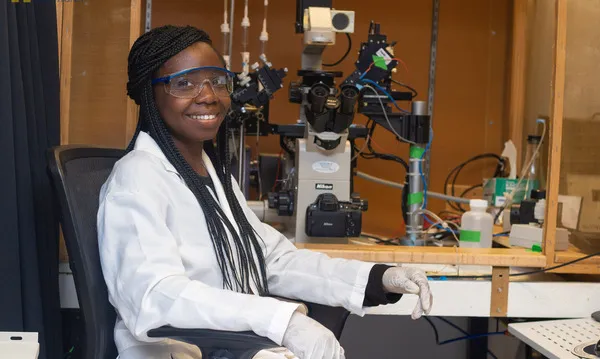
Professor Priscilla Kolibea Mante is a Ghanaian neuropharmacologist, pharmacist, academic and science communicator whose work focuses on epilepsy, depression, anxiety, neuroinflammation and the development of medicines from African medicinal plants.
She is a Professor of Pharmacology at the Kwame Nkrumah University of Science and Technology (KNUST), where she teaches and conducts research in the Faculty of Pharmacy and Pharmaceutical Sciences. She is also associated with the Centre for Applied Research and Innovation in Supply Chain–Africa, known as CARISCA.
Education and early career
Professor Mante studied Pharmacy at KNUST and obtained a Bachelor of Pharmacy degree from the university. She later completed a PhD in Pharmacology at KNUST.
Her interest in neuroscience and medicine developed through her work with patients affected by neurological and mental health conditions. She was particularly influenced by the need to find better treatments for people living with epilepsy, depression and chronic pain.
She also undertook postdoctoral training at the University of Michigan in the United States through the African Presidential Scholars Programme. The training expanded her experience in neuropharmacology, drug discovery and laboratory research.
Research into epilepsy
One of Professor Mante’s main research interests is epilepsy, a neurological condition that causes recurrent seizures.
Her work examines why some people do not respond adequately to available anti-epileptic medicines. This condition is often described as drug-resistant or treatment-resistant epilepsy.
She studies the biological mechanisms behind seizures and investigates possible therapeutic compounds that may provide better treatment options. Her research uses laboratory models, pharmacological testing and techniques that examine how medicines affect nerve cells.
A key part of her work involves studying voltage-gated sodium channels. These channels help control the electrical activity of nerve cells. Abnormal electrical activity in the brain can contribute to seizures, making sodium channels important targets for the development of anti-epileptic medicines.
Professor Mante’s research also explores how natural compounds may influence these channels and other systems involved in brain disorders.
African medicinal plants and drug discovery
Professor Mante has investigated the medicinal properties of several African plants. Her research has examined whether plant extracts and isolated compounds may have anticonvulsant, antidepressant, anti-anxiety, anti-inflammatory or pain-relieving effects.
Her work does not treat traditional claims as proof of medical effectiveness. Instead, the plants and compounds are subjected to scientific testing to determine their activity, safety and possible mechanisms.
This approach is important because traditional medicine remains widely used in Ghana and across Africa. Scientific research can help identify promising compounds, rule out harmful remedies and support the development of safe, standardised medicines.
Neuroinflammation and the brain
Another area of Professor Mante’s work is neuroinflammation, which refers to inflammatory activity in the brain and nervous system.
Inflammation can play a role in several neurological and psychiatric conditions. Researchers are studying how inflammation may influence seizures, depression, brain injury and other disorders.
Professor Mante’s work examines possible links among the brain, the immune system and treatment response. Newer aspects of her research also explore the gut-brain axis, which describes communication between the digestive system and the brain.
This area of research could help scientists understand why people respond differently to medicines and how treatments can be developed for individual patients.
Brain health as a public health issue
Professor Mante has called for brain health to receive greater attention as a public health priority in Ghana.
Speaking at KNUST’s ScienceFriday programme, she highlighted gaps in neurological data, specialised services and trained professionals. She noted that the country needed better information about the number of people living with neurological and mental health conditions.
Without reliable data, it becomes difficult for health authorities to plan services, train specialists, provide medicines and allocate resources effectively.
Her call also drew attention to the need to reduce stigma. People living with epilepsy, depression and other neurological conditions may face discrimination, social isolation or delays in seeking medical care.
Professor Mante has encouraged greater public education and stronger integration of brain health into national healthcare planning.
Pharmaceutical innovation
Professor Mante has been involved in efforts to translate laboratory research into practical pharmaceutical products.
This year, she led a KNUST project aimed at developing a sustained-release tablet from a locally developed herbal pain medicine. The project involves KNUST, Aspee Pharmaceuticals and the Biotechnology and Nuclear Agriculture Research Institute of the Ghana Atomic Energy Commission.
The goal is to improve the formulation and production of a promising herbal medicine so that it can be manufactured on a larger scale.
The project reflects Professor Mante’s wider interest in ensuring that scientific research leads to products that can benefit patients and contribute to Ghana’s pharmaceutical self-sufficiency.
Work in pharmaceutical supply chains
In addition to her neuroscience research, Professor Mante has worked on pharmaceutical supply chains and health commodity management.
This includes issues such as medicine selection, procurement, warehousing, transportation, quality assurance and access to essential medicines.
A strong pharmaceutical supply chain is important because even effective medicines cannot help patients if they are unavailable, poorly stored, expired or too expensive.
Her work at CARISCA connects pharmacology and public health with logistics and supply-chain systems. This multidisciplinary approach allows her to consider not only how medicines are discovered, but also how they can reach patients safely and efficiently.
Academic leadership and mentorship
Professor Mante has supervised and mentored undergraduate, master’s and doctoral students in pharmacology, pharmacy and neuroscience.
Through teaching and research supervision, she has helped train a new generation of Ghanaian scientists and pharmacists.
She also serves in editorial and peer-review roles for scientific journals. She has been associated with the Ghana Pharmaceutical Journal, the African Brain Journal and Frontiers in Pharmacology.
These roles contribute to the quality of scientific research and encourage the publication of African research in international academic platforms.
Leadership in science organisations
Professor Mante has held leadership positions in scientific and academic organisations.
She served as Chair of the Ghana Young Academy and later became Co-Chair of the Global Young Academy. These organisations promote the participation of early-career researchers in science, public policy and international development discussions.
She has also been involved with the African Academy of Sciences, the World Academy of Sciences, the Society for Neuroscience, the International Society for Neurochemistry and the Ghana Neuroscience Society.
Women in science and global policy
Professor Mante has advocated for greater participation by women and young researchers in science, technology and innovation.
She has served on UNESCO’s Global Advisory Committee for Women and Girls in Science and has participated in international discussions on science systems, ethical innovation and research policy.
She has also contributed to global conversations about artificial intelligence, responsible research and equitable access to scientific opportunities.
Science communication
Professor Mante is also committed to making science easier for the public to understand.
She founded WriteShop Ghana, an initiative that helps students and researchers improve their writing and publication skills.
She has also supported science engagement programmes such as Brain Bee Ghana, Two-Minute Thesis and STEM Elevate. These programmes expose young people to scientific ideas, public speaking, research communication and career opportunities in science.
Awards and recognition
Professor Mante has received several awards and fellowships for her scientific research and leadership.
She was a recipient of the L’Oréal-UNESCO For Women in Science regional recognition and an OWSD Early Career Fellowship. She has also been recognised through international research and science leadership programmes.
Her work has earned attention for combining pharmacology, neuroscience, natural-product research and science policy.
The World Intellectual Property Organization has also featured her career and advice to young scientists, including her emphasis on confidence, persistence and avoiding fear-based career decisions.
Professor Mante’s career shows how Ghanaian research can contribute to local healthcare, international scientific knowledge and the broader development of Africa’s science and innovation systems.
Sources mentioned: Kwame Nkrumah University of Science and Technology, CARISCA, the International Science Council, the World Intellectual Property Organization and the Ghana Young Academy.


0 Comments