
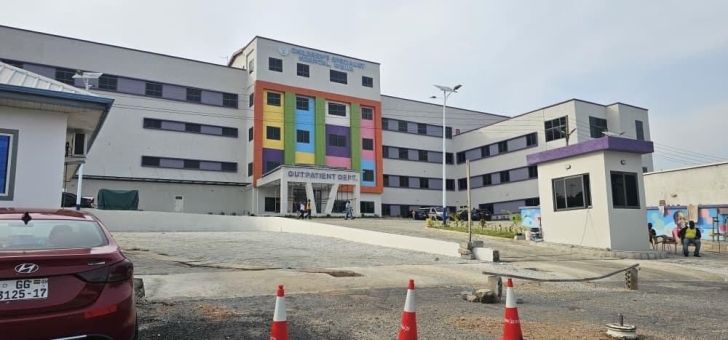
A 120-bed children’s specialist hospital — fully furnished, fully equipped, and widely described as one of the most advanced paediatric facilities in Ghana has sat locked and idle in Weija-Gbawe for nearly two years.
Air conditioners have been running since 2025 just to preserve the installed equipment. Children in the community have been turned away. Families have driven past it on their way to distant hospitals for emergency care. At least one resident described watching a child collapse, only to arrive at the hospital and find the gates shut.
On Tuesday, May 5, 2026, residents had had enough. Dressed in red and black, they took to the streets.
But what is stopping this hospital from opening? The answer involves a World Bank mis procurement declaration, a government ministry under pressure, a contractor threatening legal action, and a community paying the price for a dispute it did not create.
What the hospital is and what it was meant to do
The Weija-Gbawe Children’s Specialist Hospital is a 120-bed specialised facility designed to be the largest children’s hospital in Ghana. The project, funded by the World Bank, is equipped with neonatal and paediatric intensive care units, a 100-bed ward, a mother’s hostel, and emergency services. It was constructed by Awerco Construction Limited as part of broader efforts to improve paediatric healthcare in the Weija-Gbawe Municipality and surrounding areas.
Once operational, the facility was expected to serve as a key referral centre for paediatric care, helping to reduce congestion at existing health facilities and improve outcomes for critically ill children in Weija-Gbawe and surrounding communities.
The facility was completed in late 2024. It has not seen a single patient.
World Bank mis procurement declaration
A World Bank review, dated September 1, 2025, signed by Robert Taliercio, Division Director for Ghana, Liberia, and Sierra Leone, Western and Central Africa Region and addressed to the Minister of Finance, Dr Cassiel Ato Forson, indicates the overpricing of contract sum compared to market rate.

The World Bank’s findings: Prices 3 to 11 times the market rate
The stalemate traces directly to the World Bank Procurement Post Review (PPR) conducted between April 8 and 12, 2025, covering contracts awarded under the Ghana COVID-19 Emergency Preparedness and Response Project (IDA Credit 7125-GH), under which the hospital’s medical equipment was procured.
The review found serious deviations from the World Bank’s Procurement Regulations in the contract awarded to Awerco Construction Limited for the supply and installation of additional medical equipment at the facility, specifically Contract No. GH-COVID-19-442477-GO-DIR.
The PPR determined that prices charged under the contract, were non-compliant with World Bank procurement rules, which require that prices be reasonable and consistent with market rates. The review found that for most key items under the contract, prices charged reached 3 to 11 times the market rate.
As a result, the World Bank declared mis procurement of goods in the amount of US$3.8 million, the full value of the contract — rendering it ineligible for financing and cancelling the funds entirely.
“We sincerely regret that the World Bank has had to take this decision and are confident that the Government of Ghana will take corrective measures to avoid a similar situation in the future,” World Bank Division Director for Ghana, Liberia, and Sierra Leone, Robert Taliercio, wrote to the Finance Minister.
The Ministry of Health position: Mis procurement blocked payments, contractor blocked access
In a statement on May 5, 2026, signed by the Ministry’s spokesperson, Tony Goodman, the Ministry said the hospital is a World Bank-funded project which started in 2023 and was expected to be completed in December 2025. The statement noted that in 2024, the World Bank raised concerns about mis procurement, which included inflated costs of medical equipment up to about 11 times the actual price, and that this led to the World Bank’s decision not to settle outstanding payments related to the project.
The Ministry said it had taken steps to engage all relevant stakeholders and was prepared to commission the hospital, but the contractor halted the process, insisting that all outstanding issues be resolved before access to the facility could be granted.
In essence, the Ministry’s position is a two-part explanation: first, the World Bank’s mis procurement finding disrupted project financing; and second, the contractor is withholding access to the completed facility pending resolution of outstanding payments.
The Contractor fires back: “Unfounded and without evidential basis”
Awerco Construction Limited has rejected the Ministry’s account in forceful terms. In a letter dated May 8, addressed to the Minister of Health through spokesperson Tony Goodman, the company’s lawyers at A.E.K. Kodjoe & Associates said the Ministry’s May 5 press release titled “Operationalisation of the Weija Paediatric Hospital” misrepresented the facts and damaged the contractor’s reputation. The statement took issue with the Ministry’s claim that the World Bank had raised concerns in 2024 about mis procurement, with Awerco describing the allegation as “unfounded and without any disclosed factual or evidential basis.”
The company said the World Bank’s concerns were never communicated to it, adding that had they been, it would have provided a response. Awerco also accused the Ministry of using press releases to deny the company payments due under its contract with the Government of Ghana.

On the question of who controls access to the facility, the contractor was equally direct. The company clarified that it received a letter from the Ministry on March 18, 2026, acknowledging completion of construction works and the Ministry’s intention for immediate occupation and operationalisation. Awerco said it responded on March 27, 2026, outlining handover procedures and outstanding financial obligations.
Despite the payment issues, the company said it facilitated a visit from a team from the Ministry and Ghana Health Service to the facility on March 27, 2026, and promised to communicate a handover date. It said the Ministry has yet to receive the facility.
The contractor described the Ministry’s press release as an attempt to divert public attention from the Ministry’s own inaction and the real issues which have delayed the operationalisation of the completed hospital. It demanded a retraction within 24 hours, warning it would pursue all available legal remedies if the Ministry failed to comply.
The MP’s verdict: Stop the blame game, open the hospital
The Member of Parliament for Weija-Gbawe, Jerry Ahmed Shaib, rejected the Health Ministry’s explanation that procurement irregularities and a funding dispute with the World Bank justify the delay, saying “this shifting of blame is not a true representation of the matter.” Shaib insisted that the contractor’s agreement is solely with the Ministry of Health, not the World Bank and therefore the government bears responsibility for resolving any disputes without delaying the hospital’s opening.
The MP recounted visiting a nearby hospital where a patient was receiving oxygen while seated due to a shortage of beds, despite the availability of the completed facility. “You can imagine how much money we are paying just to keep the lights on and maintain equipment like the CT scan. You can also imagine the lives we’ve lost,” he said.
By Evans Effah

0 Comments