
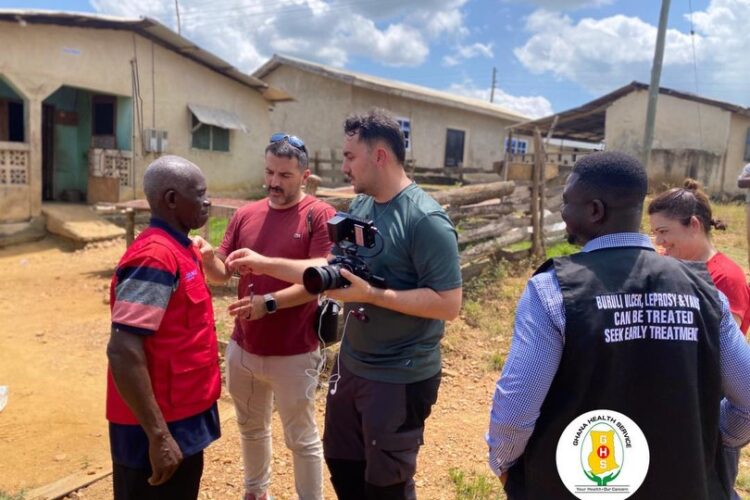
A delegation from Anesvad Foundation in Bilbao Spain, led by Elssie Ansareo has begun a field visit to Ghana to document the impact of ongoing efforts to control, eliminate, and eradicate skin-related neglected tropical diseases (NTDs).
The visit forms part of ongoing efforts to document the progress and impact of the multi-year intervention being implemented in collaboration with the Ghana Health Service.
The project, which began in 2018 with 15 districts, expanded by an additional nine districts in its second phase and has now entered a third phase with the inclusion of two more districts, Ellembelle in the Western Region and Wenchi in the Bono Region. This brings the total number of participating districts to 26, spanning eight regions: Upper West, Bono, Bono East, Western, Eastern, Central, Oti, and Ashanti.
The team, accompanied by the Acting Programme Manager of the National Buruli Ulcer Control and Yaws Eradication Programme of the Service, Dr. Horlali Yao Gudjinu, paid a courtesy call on the Eastern Regional Health Directorate to brief them on the purpose of their visit.
Speaking on behalf of the Eastern Regional Director of Health Services, Samuel Bortei Borlabi assured the team of the region’s full support and readiness to collaborate. He commended the foundation for its sustained contribution to testing and treating NTDs within the region.
As part of the visit, the team proceeded to the Ayensuano District Health Directorate, where data presented indicated notable progress in reducing disease burden.
Yaws cases declined from 54 confirmed cases in 2017 to just two in 2020, with a slight increase to 15 cases in 2025. Buruli ulcer cases also showed a general downward trend, while leprosy recorded zero cases in both 2022 and 2023, though four cases were reported again in 2025.
District Director of Health Services for Ayensuano, Francis Kwotua Apungu, expressed appreciation to the foundation for its continued support. He highlighted the impact of logistical assistance, particularly a vehicle provided to the district, which has enhanced not only NTD-related activities but also broader health outreach programmes by improving mobility for health officers.
The team also visited the Duodukrom CHPS compound in the Ayensuano District, where they engaged with community members who have benefited from early detection and treatment of NTDs.
These interventions have helped prevent disease progression to severe stages that can result in deformities. At the Duodukrom D/A Basic School, the team interacted with pupils and observed both a sensitization session and screening exercises for NTDs.
The delegation is expected to continue its visit to the Ellembelle district later in the week to evaluate preparedness for the third phase of the project, particularly as this district is newly enrolled.
The initiative is a joint, integrated effort involving the National Buruli Ulcer and Yaws Eradication Programme, the National Leprosy Programme, and the Neglected Tropical Diseases Programme under the Ghana Health Service with funding support from Anesvad Foundation, working collectively to reduce the burden of skin-related NTDs and improve health outcomes in affected communities in the country.


0 Comments