

Former Minister of Health, Bernard Okoe Boye, has attributed Ghana’s persistent “no-bed syndrome” to structural design flaws and systemic inefficiencies within the health sector rather than simply a shortage of beds.
His comment follows the death of Charles Amissah, a 29-year-old man who reportedly died after being refused treatment at three major health facilities in the capital—Ridge Hospital, Korle Bu Teaching Hospital, and the Ghana Police Hospital—due to a lack of available beds.
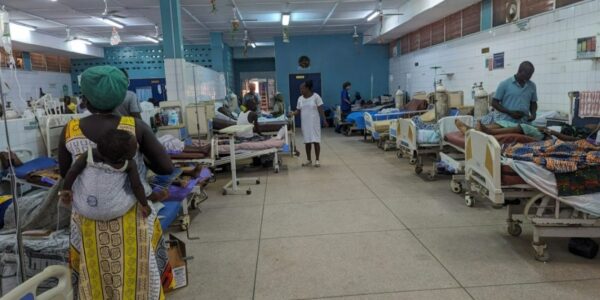
Amissah’s death has reignited discussions around a phenomenon commonly referred to as “no-bed syndrome,” a situation in which major health facilities turn patients away because they have no beds to admit them.
Speaking on The Big Issue on Channel One TV on Saturday, February 21, 2026, Dr. Okoe Boye explained that the recurring crisis in emergency units is a symptom of broader operational and infrastructural challenges.
According to him, hospitals function much like factories, where patient flow must be carefully managed to avoid bottlenecks.
“A hospital is just like a factory. When you are coming into the hospital, the entry is where we have the emergency. But when you are stabilised, you are then moved into other departments,” he said.
He noted that delays in transferring stabilised patients from emergency units to the wards often create congestion at the point of entry, even when beds may be available elsewhere in the facility.
“Sometimes people stay too long at the emergency side, while there are beds that can receive them. Monitoring and effective supervision can help keep the conveyor moving so that we can always create space at the emergency units,” he explained.
Dr. Okoe Boye further stated that equipment limitations in general wards also contribute to the problem. In some cases, doctors are reluctant to transfer high-dependency patients from emergency units if the required monitoring equipment is not available in the wards.
“Sometimes the equipment for a high-dependent person may not be in the wards, so the doctor is anxious that when he takes you from the emergency unit, that level of care drops. So they prefer to keep you a little longer until you are stable. By doing so, you are blocking the new entrant,” he added.
Beyond operational inefficiencies, the former minister pointed to structural design issues in hospital infrastructure. He observed that many hospitals were built with a larger number of ward beds but comparatively fewer emergency and intensive care unit (ICU) beds.
“Our hospitals are designed such that there are so many beds in the wards, but few are at the emergency ward and ICU. With the structural designs, we must start looking at that again,” he said.
He stressed that in densely populated urban areas, hospital design must reflect demographic realities. Citing World Health Organisation (WHO) standards, he indicated that for every 1,000 people, there should be five emergency beds.
Using Ledzokuku as an example, with an estimated population of about 300,000, he suggested that approximately 40 emergency beds would be required to meet recommended standards. However, facilities such as the LEKMA Hospital serve not only Ledzokuku but surrounding communities, including Teshie, Sakumono, and Krowor, leading to frequent overcrowding.
He noted that attempts to transfer patients to other facilities, such as the Police Hospital, often prove ineffective because those institutions face similar capacity constraints.
“To correct this, it is either we either expand the emergency wards as a quick measure,” he suggested.
Citinewsroom.com

0 Comments