
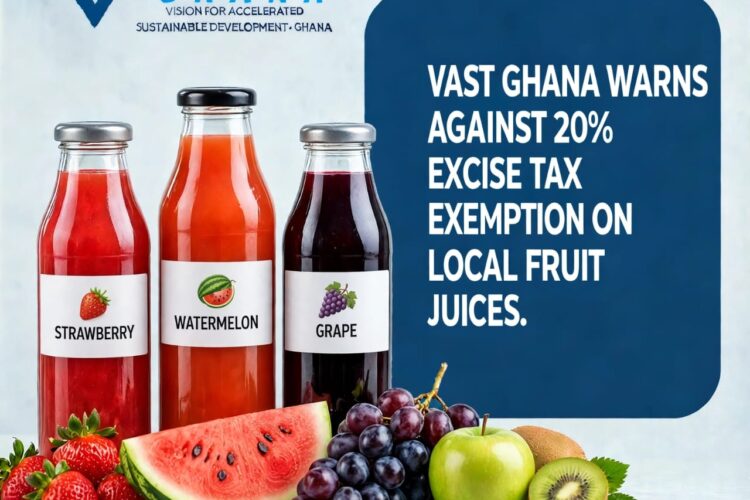
Vision for Accelerated Sustainable Development Ghana (VAST Ghana) has warned that the 20% excise tax exemption for locally produced fruit juices under the Excise Tax Act, 2026, could undermine Ghana’s efforts to prevent non-communicable diseases (NCDs).
In a statement issued on Monday (October 26), the organisation urged the Ministry of Finance to reconsider the exemption, cautioning that it could encourage the consumption of beverages containing high levels of sugar.
VAST Ghana acknowledged the government’s objective of supporting local industry and improving the competitiveness of domestic manufacturers but argued that such incentives should not compromise public health.
It said fruit juices are not automatically healthier alternatives to other sugar-sweetened beverages, as some may contain substantial amounts of free sugars that increase the risk of obesity, type 2 diabetes and other diet-related diseases.
The organisation also questioned how the government would define fruit juice for the exemption, warning that unclear criteria could create opportunities for tax avoidance and result in different tax treatment for locally produced and imported beverages with comparable sugar content.
VAST Ghana called for an evidence-based approach that taxes beverages according to their sugar content, regardless of where they are produced. It said such a system could encourage manufacturers to reduce sugar levels while ensuring fairer treatment across the industry.
The organisation also urged the Ministry of Health to raise concerns about the exemption, citing potential implications for the sustainability of the Ghana Medical Trust Fund and the government’s Free Primary Health Care Policy.
It further called for clear product classification standards, accurate labelling of sugar content and fruit composition, and regular compliance monitoring to ensure that only products meeting defined criteria qualify for the exemption.
VAST Ghana urged the government to review the measure in future tax reforms and work with the Ministry of Health, the Food and Drugs Authority and other stakeholders to ensure that industrial incentives support local production without weakening public health protections.



0 Comments